Choosing the right size for your home’s drainage system isn’t a decision most people make more than once — which means getting it right the first time matters enormously. Whether you’re replacing an aging setup or outfitting a new build, understanding the difference between a 6-inch gutter guard and a 7-inch gutter guard can save you from persistent water damage, costly repairs, and years of unnecessary maintenance headaches. Size, in this context, is far more than a number — it’s an engineering decision with real consequences for how well your home handles water over time.
Why Drainage Channel Size Matters More Than Most Homeowners Think
The primary function of any roofline drainage system is deceptively simple: collect water as it runs off the roof and redirect it safely away from the foundation. When that system is undersized for the volume of water it needs to manage, overflow becomes inevitable. And overflow doesn’t just mean a waterfall off the edge of your roofline during a heavy rain — it means persistent moisture exposure to your fascia boards, siding, foundation, and landscaping.
The size of your drainage troughs directly determines their water-carrying capacity. A wider, deeper channel can process significantly more volume per minute than a narrower one. This matters most during high-intensity rainfall events — the kind that dump several inches of water in under an hour — when the difference between an adequately sized system and an undersized one becomes immediately, visibly apparent.
Beyond raw capacity, size also affects how debris moves through the system. Larger openings are less prone to stubborn blockages caused by wet leaf clumps, seed pods, and organic buildup. This means less frequent maintenance, longer intervals between professional cleanings, and a lower overall cost of ownership across the lifespan of the system.
Breaking Down the 6-Inch Option: Where It Works Best
The 6-inch drainage channel is the most widely installed residential option across North America, and for good reason. For the majority of single-family homes, it offers a well-balanced combination of capacity, cost-effectiveness, and aesthetic proportion. A channel that is too wide for the roof it serves can look visually out of place — an often-overlooked consideration that affects curb appeal and resale value.
Here are the situations where the 6-inch profile typically performs at its best:
- Moderate rainfall climates where annual precipitation stays below 50 inches and intense storm events are infrequent
- Smaller roof surface areas with less than 1,000 square feet of total catchment area per drainage run
- Homes with minimal tree coverage, reducing the volume of organic debris entering the channels
- Properties with existing 6-inch downspout infrastructure, where a full system replacement would be prohibitively expensive
- Budget-conscious projects where cost per linear foot is a primary constraint
It’s worth noting that even within the 6-inch category, material choice — aluminum, copper, steel, or vinyl — significantly affects durability, weight tolerance, and long-term performance. The size sets the capacity ceiling; the material determines how long the system can maintain it.
The Case for Going Bigger: What the 7-Inch Profile Brings to the Table
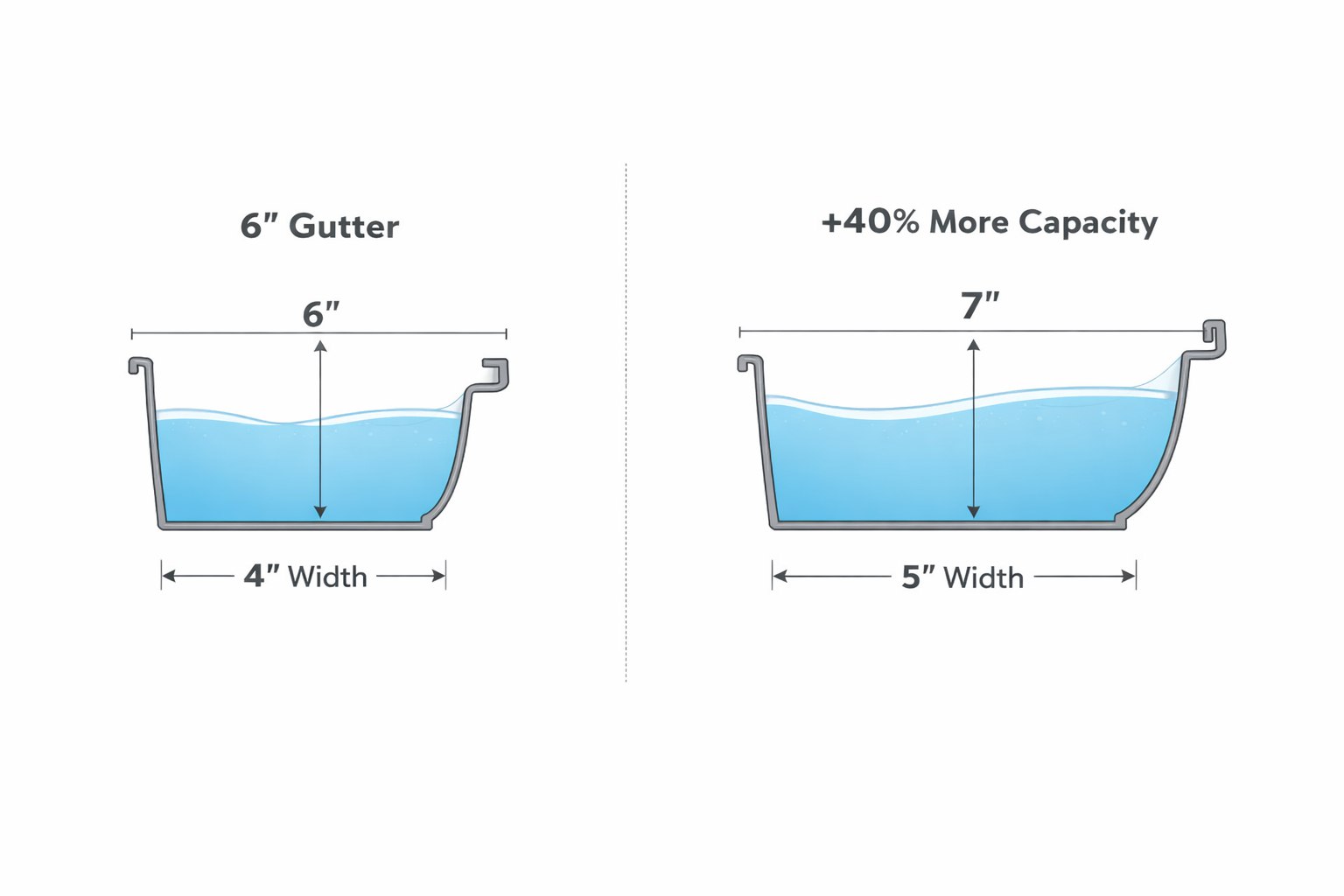
A 7-inch drainage trough holds roughly 40 percent more water volume than its 6-inch counterpart. That seemingly small dimensional difference translates into a substantial performance gap when conditions push the system toward its limits. For certain homes and climates, that extra capacity isn’t a luxury — it’s a necessity.
The 7-inch option excels in the following scenarios:
- High-rainfall regions, particularly coastal areas and the Pacific Northwest, where seasonal storms can deliver multiple inches of rain within hours
- Large roof footprints where significant surface area funnels enormous water volumes into the drainage run during even moderate storms
- Steeply pitched roofs that accelerate runoff speed, creating surge conditions that overwhelm narrower channels
- Properties surrounded by mature deciduous trees, where the volume of debris entering the system demands wider clearance to prevent blockages
- Multi-story homes where the consequences of overflow are more severe due to increased water pressure and longer fall distance
The 7-inch system also pairs naturally with larger downspouts — typically 3-by-4-inch rectangular or 4-inch round profiles rather than the standard 2-by-3-inch — which further enhances the overall drainage capacity and reduces the risk of backups forming at the point where the channel meets the vertical drop.
Side-by-Side Comparison: Making the Decision Concrete
| Factor | 6-Inch Channel | 7-Inch Channel |
|---|---|---|
| Water capacity | Standard | ~40% greater |
| Ideal roof size | Up to ~1,000 sq ft per run | 1,000+ sq ft per run |
| Best climate | Moderate rainfall | High rainfall or intense storms |
| Debris handling | Good | Excellent |
| Cost per linear foot | Lower | Moderately higher |
| Aesthetic proportion | Standard homes | Larger or more prominent rooflines |
| Downspout pairing | 2×3″ or 3″ round | 3×4″ or 4″ round |
The decision rarely comes down to a single factor. Most experienced contractors evaluate the complete picture: total roof surface, average rainfall intensity, roof pitch, surrounding vegetation, and the homeowner’s appetite for ongoing maintenance. A home that checks three or four boxes in the 7-inch column should not be fitted with a 6-inch system simply because it costs less upfront — the downstream expenses of overflow damage and repeated gutter cleaning will rapidly eliminate any initial savings.
Professional Assessment vs. Guesswork: Why the Stakes Are High
Many homeowners make this decision based on what their neighbors have, what the previous owner installed, or simply what the hardware store had in stock. None of these are reliable criteria. Rooflines are highly individual — two homes of similar square footage can have dramatically different drainage requirements depending on pitch, orientation, overhanging vegetation, and local climate patterns.
A professional assessment typically involves measuring the total catchment area of each roof section, calculating expected peak flow rates based on regional rainfall data, evaluating the current state of downspout placement and sizing, and identifying any existing problem zones where water management has historically been inadequate.
This process takes an hour or two and eliminates the guesswork that leads to undersized systems, premature failures, and expensive water damage remediation. It also ensures that the guard system you select — whether 6-inch or 7-inch — is properly matched to the channel profile, which is essential for the guard to perform as designed. A mismatched guard can create worse blockage problems than having no guard at all, channeling debris into precisely the areas it was designed to exclude.
The Long View: Total Cost of Ownership

The upfront price difference between a 6-inch and 7-inch installation is real but often modest — typically a few dollars per linear foot. Over the lifespan of the system, which for quality aluminum runs 20 to 30 years, this difference becomes almost negligible. What is not negligible is the cost of choosing the wrong size.
A chronically overloaded drainage system suffers from persistent overflow, which accelerates corrosion, warps fascia boards, erodes landscaping, and eventually compromises the foundation itself. Foundation repair is one of the most expensive categories in residential construction — easily reaching five figures for moderate damage. Compared to that outcome, the premium for a properly sized, correctly guarded system looks extraordinarily reasonable.
The bottom line is straightforward: size your system for the worst conditions your property is likely to face, not the average ones. Water doesn’t respect averages — it tests maximums. A drainage system that performs adequately on a calm spring afternoon and fails during a July thunderstorm isn’t doing its job. Build for resilience, and your home will reward that decision for decades.